
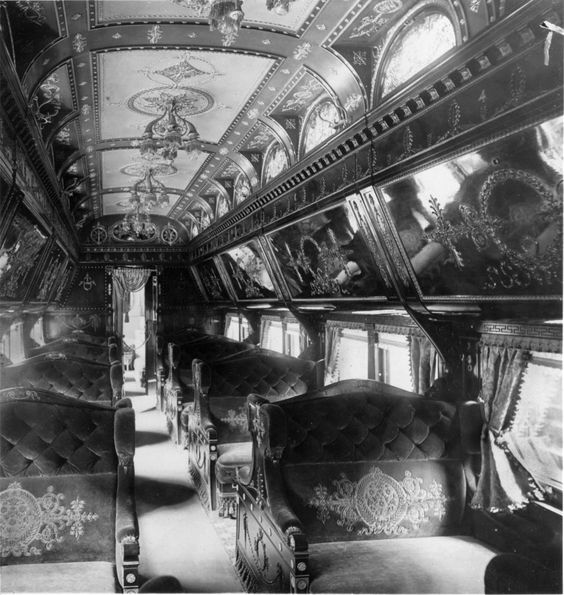
New York City after the Civil War grew exponentially, and it quickly became the financial center of the world. Investments, inventions and ingenuity paved the way for fast fortunes and new ways to show off wealth. It was also a time of rapid change in transportation, with train travel quickly eclipsing horses and steamboats, especially for those who had the urge to adventure out West, down South or even for a jaunt to the country. For wealthy families with mansions in the Hudson Valley, the train was an essential mode of transportation between their 5th Avenue homes, country estates and “cottages” in Newport.
I embarked on a mission to discover all I could about the infamous Pullman Luxury Palace Cars, which were owned by the Astors, the Vanderbilts and many other important members of New York Society. No good story based in Edwardian New York would be complete without knowing the ins and outs of train travel during this time. What I needed to figure out was how did the “private varnish” (that’s railroad lingo for a private Pullman car) get connected to the trains running up and down the Hudson? With a few internet searches and my local library system, I was able to find some great sources to help me on this adventure.
In order to appreciate the lure and fantasy of the Pullman car, it is necessary to first understand train travel in the early 1800s. Passenger trains were ugly day coaches which carried people from all walks of life as long as they could pay the fares. Day coaches were cramped, oftentimes smelly (think tobacco smoke and body odor, especially in warmer months) and they had little ventilation. If it was an overnight run, there were hideously small berths that could be pulled out for passengers to climb into, but it would certainly not be a restful night’s sleep. There was nothing romantic or glitzy about early railroad travel, but ultimately it enabled people to travel longer distances faster than a stagecoach or horse.
My research on the Hudson River Railroad line led me to the Schenectady Digital History Archive website which provides the text for the book History of the Mohawk Valley: Gateway to the West 1614-1925, Volume II, edited by Nelson Greene. I discovered that railroad companies across New York were primarily separate entities until mergers began in the 1830s and continued right through to 1914 when the full consolidation of the New York Central Line was completed across much of New York State. Prior to the mergers, the rails had different gauges for their tracks and there were often lengthy stopovers for passengers to switch to the next rail line on their journey. The railroad line which traveled on the east side of the Hudson River from New York City to Albany (and eventually on to Buffalo) became known as the New York Central and Hudson River Railroad when it was consolidated by Cornelius Vanderbilt in 1869; this is the line to which wealthy Hudson Valley residents connected their private cars.
As for learning more about the private cars themselves, I found the book, Mr. Pullman’s Elegant Palace Car by Lucius Beebe through my local library; it was a fantastic source of all things Pullman. The best part? It’s FILLED with pictures! Unfortunately, they are in black and white (the book is copyright 1961), but even without color, it is easy to see all of the craftsmanship that went into each of these beautiful cars. I was delighted to learn while reading that Darius Ogden Mills (father-in-law to Ruth Livingston Mills of the Hudson Valley estate Staatsburgh) was the first to own a private car west of the Missouri River in 1872. Darius made his millions through investments out West in the Comstock Lode and through finance (he organized the opening of the Bank of California and was its first president). It’s always exciting when my research connects back to the people and places I am interested in!
George Mortimer Pullman grew up in Albion, New York and in his early days, he was a cabinet-maker by trade with his brother and did some work moving buildings for the Erie Canal and also in Chicago. Legend says that after an uncomfortable train ride home in an open sleeping car from Chicago, he was inspired to improve train comfort. He started a company and earned a contract with a western rail company, developing two cars, the Pioneer and the Springfield. Pullman’s new company gained notoriety for luxury and style in 1865 when the Pioneer was used to transport Mrs. Abraham Lincoln home to Springfield, Illinois after she had collapsed from grief and exhaustion while traveling on her husband’s funeral train.
Pullman’s business took off within a few years, drawing both the attention and the investment funds of Andrew Carnegie along with other prominent businessmen who were intrigued by his dream of building comfortable dining, sleeping and parlor cars. Until then, there were very few companies creating luxurious replacements for the day coach. His first “hotel on wheels,” as he called it, included its own porters, a full service kitchen and dining room attached to a sleeping car. This car combination became known for its delicious food and outstanding service; the name Pullman quickly became synonymous with pleasure, craftsmanship and luxury. Many railroad companies sought out Pullman’s sleeping, dining and parlor cars for lease on their lines all across the United States; American travelers wanted comfort and ease and Pullman’s cars met their expectations with well-appointed furnishings, gas lighting and gourmet dining. By the turn of the century Pullman had bought out most of his competitors and could boast that there were 260,000 beds occupied aboard his train cars each night.
As word made its way across the country, society’s Elite began to request custom palace train cars to ride the rails in privacy and style. Pullman luxury car exteriors could be a simple black enamel, or they could showcase the family’s livery colors. Each car was named, whether for the country estate, the family, or some other personal moniker, and the name was painted on the outside of the car along with the primary rail line it was commissioned to run on. The interiors of a palace car could be as ornate as the owner’s mansion on 5th Avenue with Turkish rugs; silk, velvet or leather seating; and wood paneling of mahogany, walnut or quarter sawn oak. The custom-built private car had an observation deck at the rear, a kitchen, state rooms, dining room, and a master bedroom and bathroom; some even had hot and cold running water! Pullman’s private luxury cars were literally mansions on wheels. “A private car is not an acquired taste. One takes to it immediately,” the socialite from New York, Mrs. August Belmont Jr. once said. Indeed, what could be better than traveling long distances in a train car that had all the comforts of home, including your chef and servants?
After learning about local rail lines and the Pullman palace cars themselves, I still hadn’t found the answer to my original question of how the private cars attached to the trains running up and down the Hudson River, and I almost gave up the search. After trying a different method of research, I was able to locate several snippets of information within various local archives and discovered that several prominent families actually had their own private platforms along the train tracks, including the Roosevelts and the Astors. It appears that for a fee, they had only to call ahead (or send a servant) to the rail station for their private car to be attached at the end of the next train. Most prominent families also provided their private cars for friends and relatives who traveled to their homes for parties and long weekends, and would make arrangements for the visitor to catch the train and board the attached car to bring them directly to the estate. This is exactly what Franklin and Eleanor Roosevelt did in 1939 when King George VI (who was the first English royalty to visit the United States since the Revolutionary War) visited the Roosevelt’s Hyde Park home, Springwood. It was also the first time that English royalty had ever been served hot dogs.. but alas that story is for another time…
If you’d like to see what a real Pullman private car looks like, watch this episode of Pawn Stars: Pullman Train Car Season 14. It shows a 1902 Pullman car belonging to the president of a railway and it is a fascinating time capsule with vibrant period colors and amenities; the intricate details of the craftsmanship are truly extraordinary. Unfortunately, some of the facts the Pawn Stars team uses in their text bubbles are incorrect, such as the availability of electricity and air conditioning in a private car as early as 1862. These amenities were not introduced on any train cars until the turn of the century, and even then only an electric fan, and not air conditioning was available. Air conditioning would not be invented by Carrier until 1902 and wasn’t added to train cars until around 1940. Either way, if you are interested in owning your very own Pullman car, there are some that have been restored and commercial trains like Amtrak will let you attach your private car to ride the rails in style just like a hundred years ago, all for a small fee of course.

 Evelina Wood
One thought on “Pullman and His Luxury Palace Cars”