

While working on my Gilded Age dark romance trilogy set in the Hudson Valley, I found myself asking a dangerous question:
What did crime scene investigation actually look like in the 1890s?
My heroines are young women of privilege — intelligent, observant, and far more curious than society would prefer. If they were to encounter violence or mystery, what tools would realistically have been available to them? What science existed? What knowledge was emerging?
That question led me straight into one of the most fascinating true crime histories I have ever read:
The Killer of Little Shepherds: A True Crime Story and the Birth of Forensic Science by Douglas Starr.
It was exactly the book I didn’t know I needed.
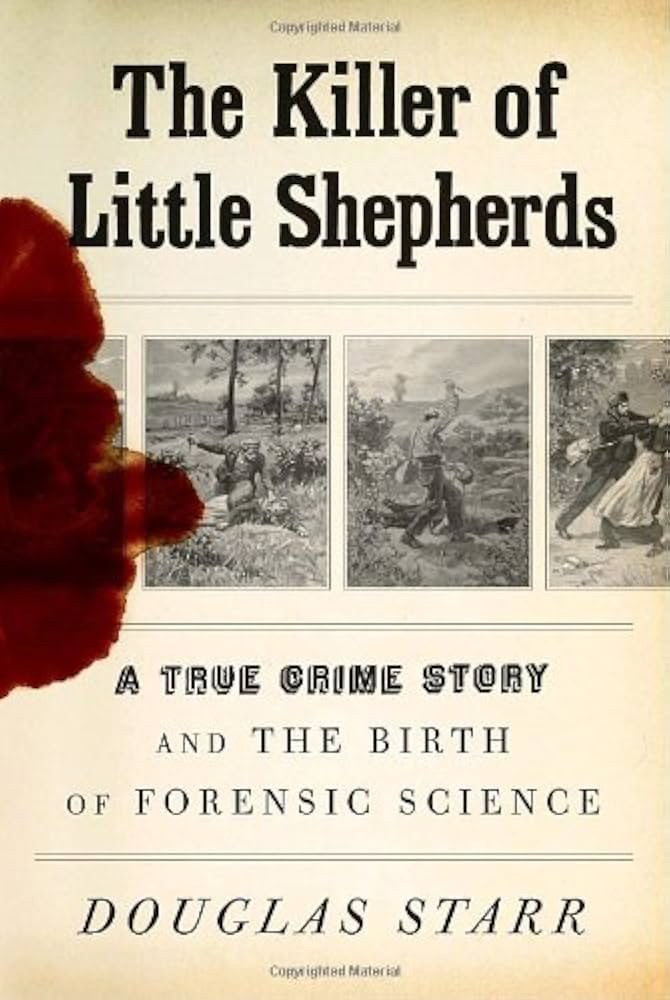
At its core, Little Shepherds tells the chilling story of Joseph Vacher — monk-turned-soldier-turned-vagabond — who terrorized rural France during the 1890s in a largely undetected killing spree.
For years, his crimes went unconnected. Local authorities saw isolated tragedies. Villagers recalled a scar-faced wanderer. But no one recognized a pattern.
By the time Vacher was apprehended in 1897, the case had grown into an international sensation. His 1898 trial drew journalists from across Europe and the United States. For one of the first times in history, the public followed a criminal case through telegraph reports and mass-market newspapers. The world debated:
Was he sane?
Was he a calculating monster?
Did he deserve the guillotine — or institutionalization?
But this is only half the story.
Running parallel to Vacher’s crimes was something revolutionary.
Dr. Alexandre Lacassagne, a pioneering French criminologist and professor of legal medicine in Lyon, began applying systematic scientific inquiry to violent crime. Alongside his students and colleagues, he studied cadavers, wound patterns, bone structure, and behavioral traits — not to sensationalize them, but to understand them.
The result was nothing short of foundational.
Their research was published in Archives de l’anthropologie criminelle, the leading criminal science journal of its era. For over thirty years, it documented case studies, emerging theories, and investigative techniques. It even examined contemporary crimes like Jack the Ripper’s murders in London and Jesse Pomeroy’s crimes in Boston. At one point, it analyzed the investigative methods of Sherlock Holmes himself.
In many ways, it was the true crime podcast of the late nineteenth century.
Lacassagne also compiled his students’ research in Travaux du Laboratoire de Médecine Légale de Lyon, a collection of theses born from observation and experimentation at the Institute for Legal Medicine. These works eventually helped form the basis of his 1892 handbook, Vade-mecum du médecin-expert (Handbook for the Medical Expert).
As Douglas Starr writes:
“By carefully following the steps in the handbook, even a harried doctor in a remote hamlet could conduct an autopsy that would lead to a righteous conviction.”
Standardization. Procedure. Method.
The scaffolding of modern forensic science had begun.
Of course, not all contemporary theories were enlightened.
Italian criminologist Cesare Lombroso, widely followed at the time, proposed that criminality could be identified through facial and skull structure — the infamous theory of the “born criminal.” His work influenced European thought significantly, even as Lacassagne and others pushed toward more rigorous medical investigation.
Meanwhile, in rural France, the gardes-champêtres — local officers more akin to game wardens — relied heavily on eyewitness accounts and community pressure. Scientific infrastructure was still limited.
And across the Atlantic, the situation was often worse.
In the late 1800s, particularly in rural counties of New York, law enforcement was frequently under-resourced and politically entangled. Sheriffs were elected officials, often from prominent local families. Coroners required little to no formal medical training. Positions could be influenced — or outright controlled — by political machines.
Medical experts were sometimes dismissed as “corruptible quacks.” Licensing laws were inconsistent. Standardization was rare.
It is highly unlikely that Lacassagne’s handbook, despite its forensic acclaim in Europe, would have been widely implemented in rural American jurisdictions at the turn of the century.
Which, for a novelist, is a fascinating tension.
Imagine a well-traveled young woman of means in the Hudson Valley at the dawn of the twentieth century.
A woman curious enough to read Archives de l’anthropologie criminelle.
Connected enough to obtain Lacassagne’s handbook.
Bold enough to tour a European institute of legal medicine — even if such pursuits were considered unsuitable for a lady of “higher sensitivities.”
Now imagine her returning home to a rural county with limited investigative resources… where corruption could flourish quietly beneath social respectability.
You can see where this is going.
And I will leave you there — while I return to plotting the next chapter of this trilogy.


